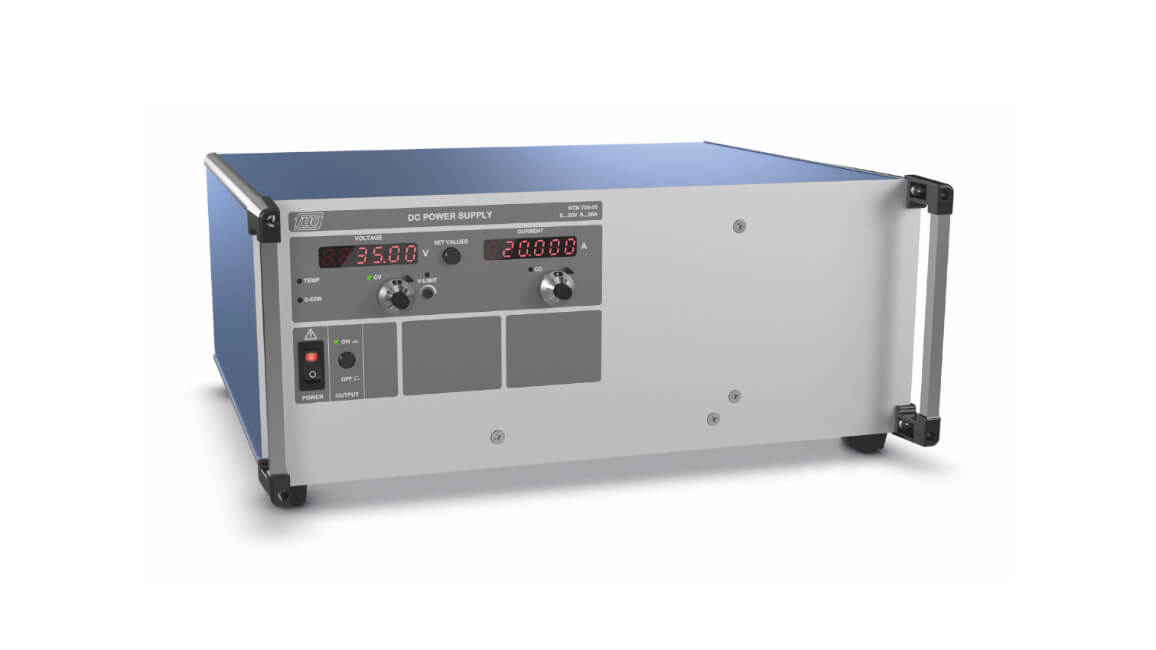
Power range up to 100.000W.
Output voltage 6.5V up to 350V, continuously adjustable from zero to maximum.
The main voltage is transformed to the appropriate level. On the secondary side of the transformer is a thyristor controlled rectifier stage (phase cutting circuit), the output of which is used to charge a capacitor bank. This capacitor bank is also connected to the final series regulating transistor output stage. By controlling the conduction angle of the thyristors after each zero-crossing of the sinusoidal voltage, the flow of energy is regulated in such a way as to have a defined voltage drop across the final series transistor stage (pre-regulation). The performance of the final series transistor stage defines the final stability of the output voltage (main regulation).
– Double stabilisation with thyristor pre-regulation and linear regulation.
– Performance of regulation with low ripple.
– Output voltage floating.
– Potential-free output voltage.
The mains voltage is first transformed to the appropriate level. On the secondary side of the transformer is a thyristor controlled rectifier stage (phase cutting circuit). The rectified voltage is smoothed by a LC-filter.
– Thyristor regulation.
– Robust in design.
– High reliability.
The main voltage is transformed to the appropriate level and rectified. The rectified voltage charges a bank of capacitors of the intermediate circuit to a constant voltage, which it is given via a set of power transistors to the output. The series transistor defines the final stability of the output voltage and the regulation speed. Optionally a set of power transistors parallel to the output can act as a current sink to provide active pull down ability. The design of linear regulated power supplies is optimised for fast programming speed.
– Linear regulation.
– Fast and precise regulation.
– Designed also to include current sink functionality for 2-quadrant operation.
Bipolar linear regulated power supplies supply one output voltage, where the value and polarity is adjustable. The main voltage is transformed to the appropriate level and rectified. The rectified voltage charges a bank of capacitors of the intermediate circuit to a constant voltage, which it is fed, via a set of serial power transistors, to the output. The output stages of the positive and the negative circuits are switched together in a push-pull manner. The regulation transistors define the final stability of the output voltage and the regulation speed. Bipolar power supplies are able to operate as 4-quadrant power amplifiers (optionally also for active loads).
– Bipolar linear regulation.
– Fast regulation.
– Bipolar adjustable output voltages (4 quadrant-operation).
Designed specifically for superconductivity applications, this superconductivity power supply family is series regulated via a set of parallel transistors which are driven from a pre-regulation stage which utilises phase controlled thyristors. In this manner, the power lost across the output transistors is kept to as minimum. Thus, the final control element always has a low power dissipation in energising and static constant current mode. In de-energising mode, the transistor stage is working as a current sink and the power is dissipated by means of either air or water cooling.
– Double stabilisation for superconducting coils.
– To charge and discharge high-inductive, superconducting coils.
– Quench detection feature.
Our air solutions' ability to reliably remove coronavirus, H1N1, EV71 and E.coli from the air you breathe are proven and tested by leading labs.
For any enquiries, assistance, further specifications or site survey discussion, please contact us for an in-depth consultation.